
Accolent ERP includes support for automotive cores that are recycled or reused in a re-manufactured (“reman”) product. To track all these parts, separate products need to be maintained for the recycled or reman product, and the core. Cores can be “clean” (e.g., a new battery core) or “dirty” (e.g., a used battery core). New products can be notionally received in as the recycled or reman products and the clean cores and then maintained as unfinished kits. Credit memos and RMAs can be created for the dirty cores.
Using Automotive Cores
- Certain types of auto parts can be recycled or re-manufactured for future sale.
- These recycled or reman products include a core charge that is a form of deposit held for the return of the used part.
- Core charges are set by the manufacturer or supplier and are based on the value of the materials in the part or the reusability of the old part.
- Core charges are sometimes set by States to ensure proper recycling and disposal of used parts.
- The core charge is added to the price of a part to encourage the return of the old part.
- The core charge is refunded with the return of the dirty core.
- To properly track cores, the recycled or reman product and the core would be set up as separate products allowing them to be tracked separately through inventory and the financials.
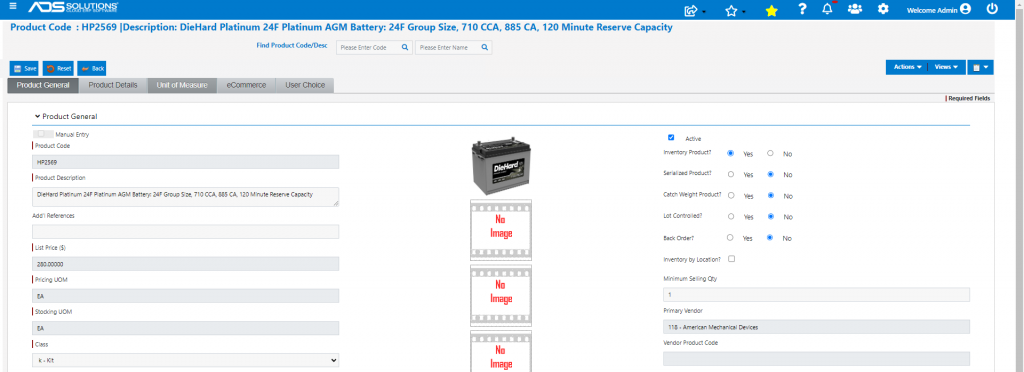
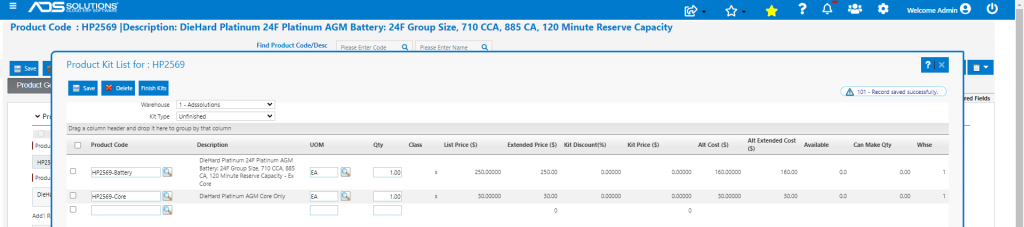
- HP2569 is an unfinished kit Diehard Platinum AGM battery – there is no need to “finish” the kit since the battery and the core cannot be separated.
- The kit components of HP2569 are the Battery and the Core.
Receiving a Product with a Core
- Car batteries are required by law in many states to be recycled and carry a core charge.
- The core charge covers the lead in the battery and certain other reclaimable materials.
- When a new battery is purchased from the manufacturer it includes the inherent clean core and will be charged for as the Battery ex-Core plus the Core and it would be received in as the Battery and clean Core.
- Receive PO C5965 for 5 x DieHard Platinum Batteries and Cores.

Selling a Product with Immediate Return of Core
- When a new battery is sold, the sale is billed for the Battery ex-Core, the Core and credited for the dirty Core returned, if physically returned.
- Create Immediate Invoice I25287 for Customer 011 and enter product HP2569 – since this is an unfinished kit, it will expand to show the Battery and the Core.
- Adjust to remove Customer discount given on the Core.
- If the buyer has the dirty Core, enter the Core product with a quantity of -1.
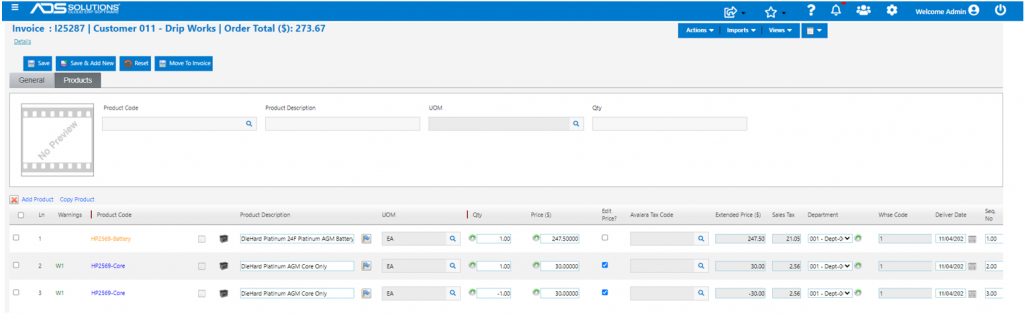
- Then take payment 8107 for the $268.20 net of an early payment discount and move to invoice.

Selling a Product with Later Return of Core
- If the buyer doesn’t have the dirty Core with him, charge for the clean Core and issue the Return Merchandise Authorization for the return of the dirty Core
- Create Immediate Invoice I25289 for HP2569, this includes the Battery and the clean Core.
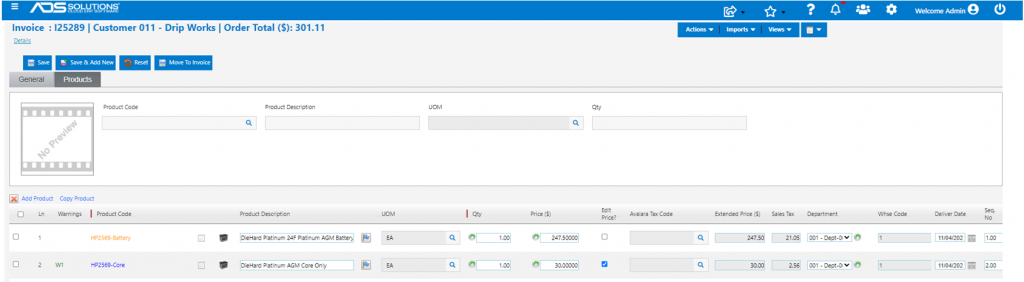
- Collect payment for the total of $295.09 for the Battery and the clean Core net of the early payment discount and invoice the transaction.

- Now create a two-step CM linked to I25289 for the return of the dirty Core.
- Create Credit Memo CM25289 for 1 dirty Core to be subsequently returned.

- Move to shipping and print RMA.
- When dirty Core is returned with the RMA, the credit can be issued.
Inventory of Dirty Cores
- When received a dirty Core, just increments the inventory of the Core product.
- It should be tracked and valued just like any other product.
- If the old battery (i.e., dirty Core) is damaged, the Core deposit should be held pending acceptance by the manufacturer.

Returning Dirty Cores
- Periodically this inventory of Cores would be returned to the manufacturer in return for a credit against new purchases.
- There are many types of automotive cores. Some examples include:
- Batteries (the core is referred to as the “Battery Core” and covers all the recyclable lead, and other reclaimable materials),
- Tires (the retreadable core is referred to as a “Tire Casing”),
- Brakes (the core is referred as a “brake shoe” as distinct from the brake pad),
- Brake master cylinders,
- Water pumps,
- Starters,
- Alternators,
- Air conditioning compressors, etc.