
Accolent ERP uses Average Cost throughout for purposes of maintaining Inventory balances and for calculating Cost of Goods Sold (COGS). If Landed Costs are entered upon PO Receiving, these are treated as direct costs of the product in accordance with GAAP and are included in Average Cost and capitalized into Inventory. The Average Cost calculations reflect the effect of every transaction that affects the inventory quantity of a product.
Average Cost Explained
- The Average Cost for any product represents the cumulative cost balance of all transactions to date divided by the ending Quantity on Hand (QOH).
- Receipt of a PO will increase the cumulative cost balance by the cost on the PO (i.e., PO cost plus allocated landed cost of that product) and will also increase the cumulative QOH. The new Average Cost is obtained by dividing the new cumulative cost balance by the new QOH.
- Sale of items will reduce the cumulative cost balance by the number of items sold multiplied by the Average Cost of those items. The reduced cumulative cost balance is divided by the new ending QOH. As a result, a sale transaction will not change the Average Cost of the product.
- There are situations in which the QOH can go negative such as if items that have been received but the system has not yet been updated for the receipt, are then sold. If the QOH goes negative, the cumulative cost balance will go negative, but the Average Cost will be unchanged.
- If a PO is received for a product that has a negative QOH the new Average Cost is set equal to the cost on the PO. In addition, a write-off is made equal to the negative beginning QOH multiplied by the difference between the PO cost and the beginning Average Cost (i.e., Write-Off = Beg (-ve) QOH x (PO cost – Beg Avg Cost)).
- The write-off means, in effect, that a sale of a negative quantity (that didn’t really exist) at the beginning Average Cost, should really have been recorded at the actual PO cost.
Average Cost Examples
- Product I2651 has an Alternate cost of $16.40/EA.
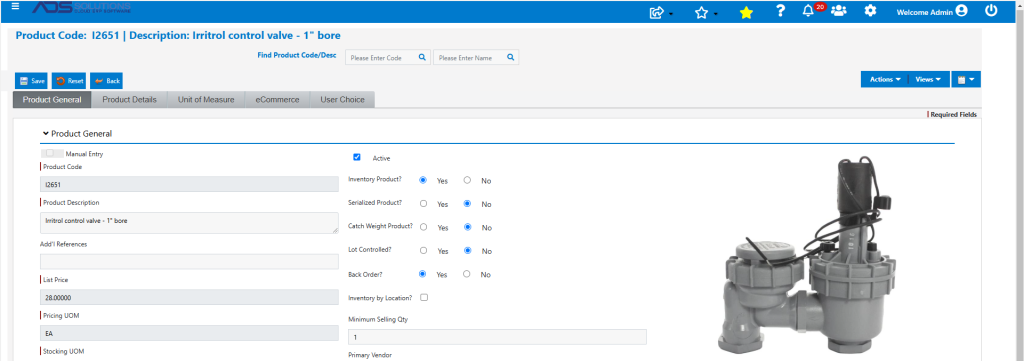
- As of 4/2/2025, the ending QOH is 26 EA and ending Average Cost is $17.40/EA.

- The cumulative cost balance for this product is 26 x $17.40 = $452.40
Receive a Purchase Order
- Receive PO C11030 for 20 EA of product I2651 at a purchase cost of $16.40/EA and record landed costs of $20.00.
- The cumulative cost balance goes up by (20 x $16.40) + $20.00 = $348.00 to $800.40, and the ending QOH goes up by 20 to 46.
- The resultant Average Cost is $800.40 / 46 = $17.40.

Enter Sales Transactions
Positive Ending Qty Available
- Create order 78085 for Customer 011, to sell a quantity of 40 EA x I2651, fulfill, then invoice.
- The cumulative cost balance goes down by (-40 x $17.40) = -$696.00 to $104.40, and the ending QOH goes down by 40 to 6.
- The resultant Average Cost is unchanged at $104.40 / 6 = $17.40.

Negative Ending Qty Available
- Now create order 78086 to sell a quantity of 15 EA and overwrite the 9 EA that is automatically back ordered. By overwriting the back order quantity, the user is allowing the system to run a negative QOH.
- Move to fulfillment and then invoice.
- This scenario is obviously not physically possible and must reflect a temporary situation in which, for example, a PO has been received at the dock but has not yet been received, or this order is prioritized over other orders that have not yet been moved to back order.
- The system will accommodate a negative QOH.
- The cumulative cost balance goes down by (-15 x $17.40) = -$261.00 to -$156.60, and the ending QOH goes down by 15 to -9.
- The resultant Average Cost is unchanged at -$156.60 / -9 = $17.40.

- The underlying assumption is that the -9 EA that didn’t really exist were sold at an Average Cost of $17.40.
Receive PO to Restore QOH to Positive
- Now receive PO No C11275 for a quantity of 20 EA at a PO cost of $16.60/EA and incur a landed cost of $28.00.
- Update the Alternate Cost to reflect a $0.20 cost increase from the vendor.
- The cumulative cost balance goes up by (20 x $16.60) + $28.00 = $360.00 to $203.40, and the ending QOH goes up by 20 to 11.
- The resultant Average Cost is $203.40 / 11 = $18.49; however, the actual effective PO Cost was $16.60 + ($28.00 / 20) = $18.00.
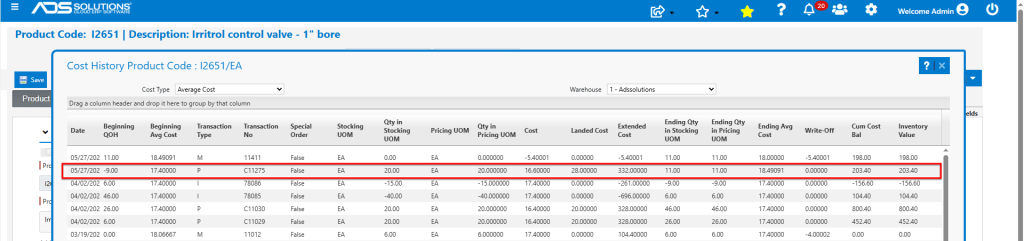
- The fact that the Average Cost exceeds the PO Cost reflects the fact that the -9 starting QOH were sold at the old Average Cost of $17.40 rather than at the PO Cost.
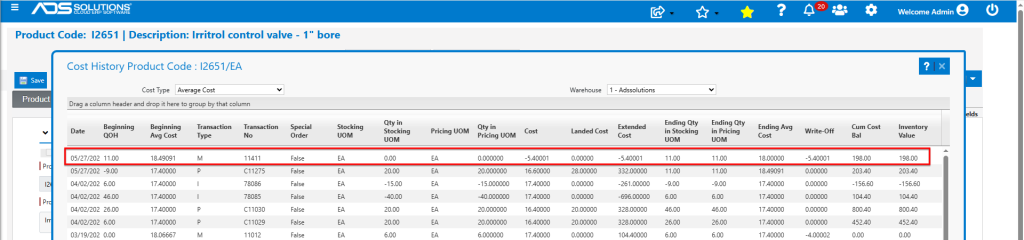
- To correct this, Accolent ERP automatically makes receipt 11411 to record a write-off to reflect the fact that the -9 EA were sold at a reduced cost.
- The write-off is calculated as -9 EA x ($18.00 – $17.40) = -$5.40. The negative sign reflects the fact that this reduces or credits inventory by the amount of the write-off.
- The Cumulative Cost Balance goes from $203.40 to ($203.40 – $5.40) =$198.00, and the Inventory Value is 11 x $18.00 = $198.00.
Manual Inventory Adjustment
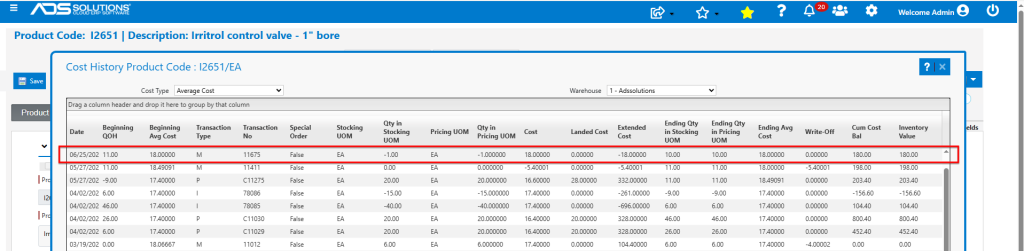
- Now make a manual inventory adjustment to reduce the quantity on hand by 1 EA from 11 EA to 10 EA
- The downward adjustment creates a write-off expense to (in this case 503-00 Inventory Shortfalls) recorded on Receipt 11675.
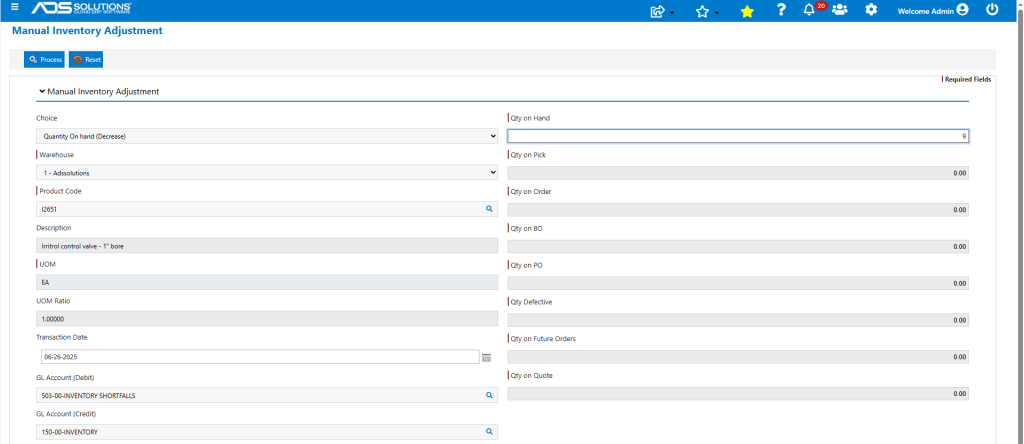
- The cumulative cost balance goes down by (-1 x $18.00) = -$18.00 to $180.00, and the ending QOH goes down by 1 to 10.
- The resultant Average Cost is unchanged at $180.00 / 10 = $18.00.
- This is the GL Posting showing $18.00.

Chronology of Average Cost
- The Average Cost is calculated from each transaction taken in strict chronological order.
- Back dated transactions, though posted to the GL as of the backdated date, do not alter the strict chronological order of the Average Cost Calculations.