
Accolent ERP uses Average Cost (or FIFO cost if selected) throughout the system for non-Lot-controlled Products. However, whether the system is set to use Average Cost or FIFO cost, Lot-controlled products will always use Lot Costing. In Lot Costing, the system records the specific Lot Cost for every Lot when it is received in, then reflects specific Lot items sold at their actual Lot Costs rather than at their Average Costs. Lot Costing is similar to the cost allocation methodology used in FIFO except that, unlike FIFO, there is no assumption made as to which items were sold (i.e., oldest first). In Lot Costing the actual Lots of each items sold are tracked and it may not be oldest first, but something else (e.g., first-to-expiry first) or some combination of different Lots.
Lot-Controlled Product
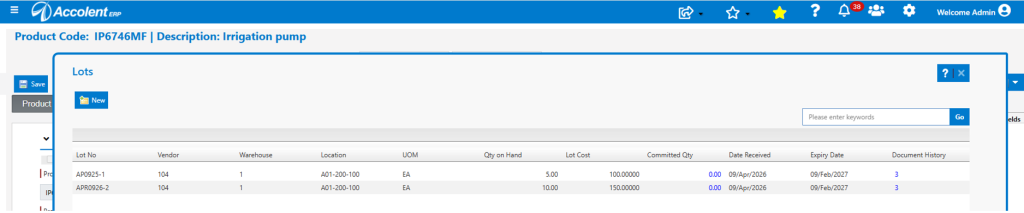
- Product IP6746MF is a lot-controlled product which means that every purchase or sale transaction will record the Lot details.
- The product is purchased on two Lots AP0925-1 and APR0926-2.
- Lot AP0925-1 has quantity of 5 EA and Lot Cost of $100/EA.
- Lot APR0926-2 has quantity of 10 EA and Lot Cost of $150/EA.
Create Order for Lot-Controlled Product
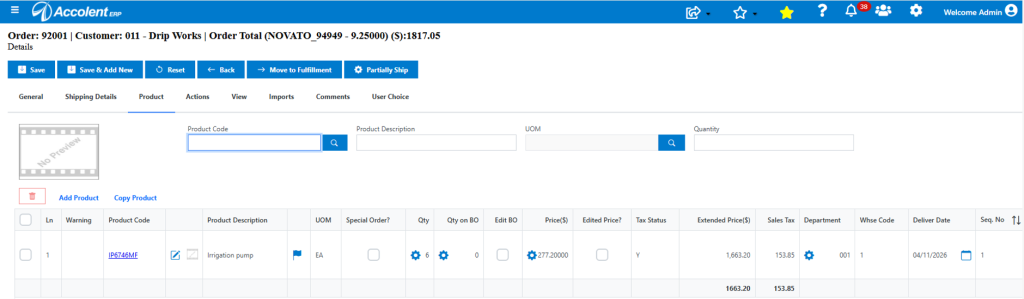
- Create order 92001 for Customer 011 for 6 EA by IP6746MF.
Move the Order to Fulfillment and Select Lots
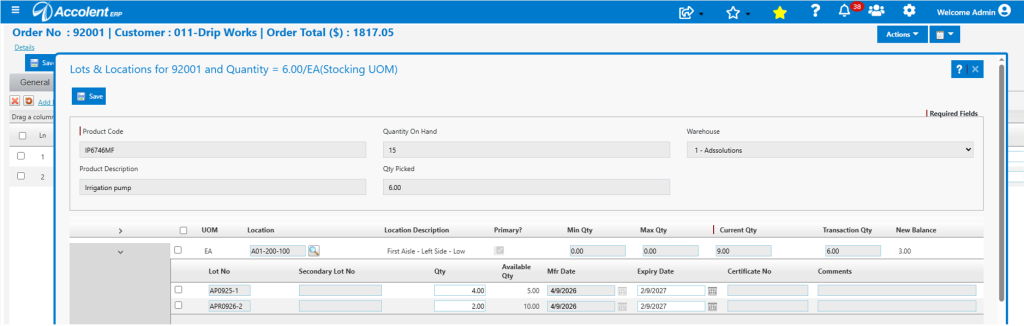
- Move the Order to fulfillment and user will then need to select the Lots picked from.
- Select 4 EA from Lot AP0925-1 and 2 EA from Lot APR0926-2.
Move the Order to Invoice
- Then move transaction to invoice.

- Now, look up GL Posting of transaction.
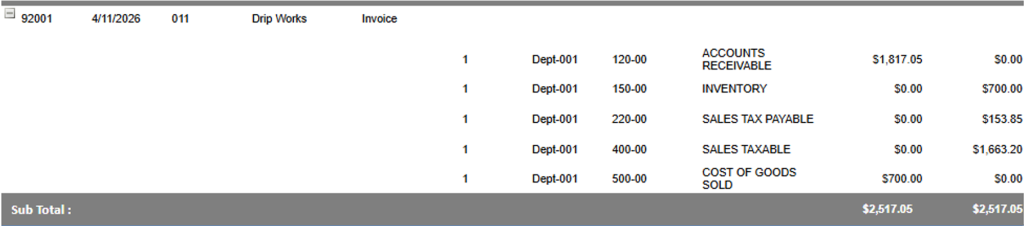
- The Sales revenue less 1% discount for customer 011 = (6 x $280) x 0.99 = $1,663.20.
- The Sales Tax of 9.25 % =$1,663.20 x 0.0925 = $153.85.
- The COGS is calculated as = (4 x $100) + (2 x $150) = $700 reflecting the Lots selected.
Recording on Product
- Go to Product IP6746MF.
- Look up Lots – reflects sale of 4 EA from Lot AP0925-1 and 2 EA from Lot APR0926-2.

- Look up the Average Cost history for the product.

- The receipt of POs for the 2 Lots AP0925-1 and APR0926-2 created Avg Cost of [(5 x $100) + (10 x $150)] / (5 + 10) = $133.33/EA.
- The cost of the sales transaction was not recorded as (6 x $133.33) = $800 (i.e., at the beginning Avg Cost of $133.33) as it would be for a regular non-Lot controlled product; instead, the cost was calculated based on the Lot Cost of the items sold (i.e., (4 x $100) + (2 x $150) = $700).
- Similarly, the ending Inventory Value is not (9 x $133.33) = $ 1,199.97 (i.e., at the ending Avg Cost of $133.33) as it would for a regular non-Lot controlled product; instead, the Inventory Value was calculated as [(1 x $100) + (8 x $150)] = $1,300 based on the Lot Costs of the items remaining.
- Also, the ending Avg Cost is not $133.33 (i.e., equal to the beginning Avg Cost of $133.33) as it would for a regular non-Lot controlled product; instead, the ending Avg Cost is $1,300/9 = $144.44 based on the Lot Cost of the items remaining.