
Accolent ERP requires a set of default GL Accounts on the Warehouse master. These Warehouse GL Defaults represent the minimum number of GL Accounts that need to be provided in order for the system to post GL transactions. You must set these warehouse GL defaults prior to entering transactions into Accolent ERP. Once these warehouse GL default accounts have been set, they should not be changed.
Warehouse GL Defaults
- To set up the Warehouse GL Defaults, go to Inventory/Products > Warehouses > List Warehouses
- Select Warehouse then go to Actions > General Ledger Defaults
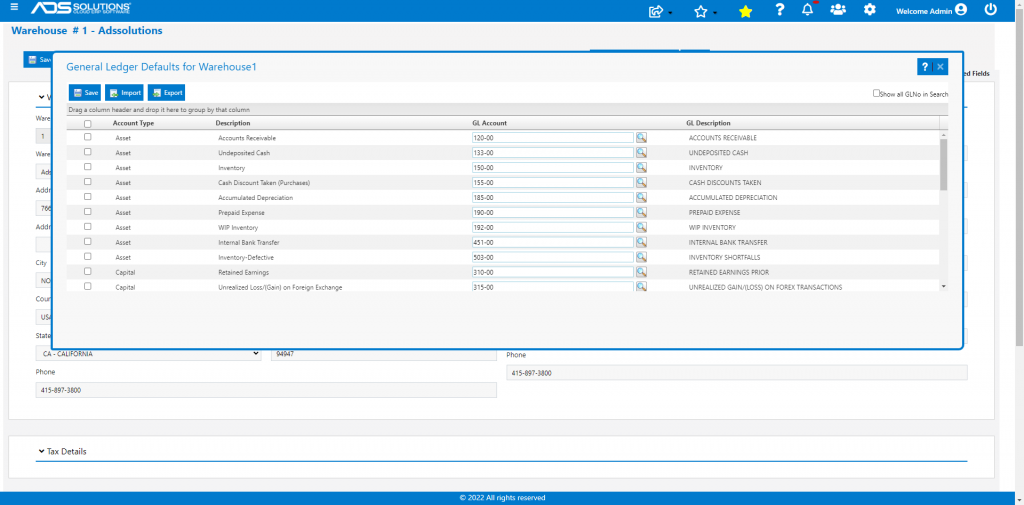
- The Warehouse GL Defaults may be exported to or imported from Excel
Use of Warehouse GL Defaults
- Every transaction that posts to the GL, is posted through an Accounting Journal to a specific GL Account by Warehouse by Department
- The General Ledger Defaults screen specifies the GL Accounts that each of these Accounting Journals post to
- These GL Defaults define the GL postings for all your automated transactions including invoices, received POs, payables, payment receipts, inventory adjustments, or unapplied payments
- By default, the first warehouse’s GL Defaults are populated with the accounts that come with the standard Chart of Accounts
- If you change the Chart of Accounts, you will need to change the warehouse GL Defaults
- To set up the GL Defaults, choose GL Accounts using the search icon to serve as the account for the function described in the Description column
- If you have more than one warehouse you will need to create the additional warehouses and populate the GL Defaults
- You will not be able to create the additional warehouse until you fill out all the accounts required in the table
- You will also have to supply at least one department for the warehouse since, inherent in all accounts is a warehouse and a department
- This structure allows you to create profit/loss centers by warehouse and department
- You can have multiple warehouses and have them all post to one set of accounts (for simplicity) and one department
GL Account Default Functions
Asset-Type Accounts
- Accounts Receivable – This specifies the GL Account to which amounts due from customers are recorded. The sales-side GL posting of the Sales Journal debits Accounts Receivable and credits the accounts for Sales and Sales Tax Payable. The GL Posting of the Payment Receipts Journal debits Undeposited Cash and credits Accounts Receivable. The Accounts Receivable account is linked to the AR Aging account. Every invoice debits Accounts Receivable and automatically makes an entry in the AR Aging table in the same amount and at the same time. Similarly every payment credits Accounts Receivable and reduces AR Aging by the same amount and at the same time. The Accounts Receivable balance should always match the AR Aging balance before interest, discounts and write-offs.
- Accumulated Depreciation – This specifies the GL Account in which the cumulative amount of depreciation expense is recorded. The GL Posting of the General Journal debits Depreciation Expense and credits Accumulated Depreciation. The depreciation GL posting happens from the Depreciated Cost of Rental Products screen as well as the GL adjustments made to periodically record depreciation. This is a contra-asset account.
- Cash Discount Taken (Purchases) – This specifies the GL Account to which purchasing discounts are recorded. Many vendors provide payment terms that provide for a discount. The GL Posting of the Cash Disbursement Journal debits the full amount (i.e., undiscounted) of a vendor’s invoice to Accounts Payable, debits the amount of the payment discount to this account, and credits the net payment to Cash in Bank.
- Internal Bank Transfer – This is a special-purpose GL Account to which bank transfers are recorded. A transfer from a bank account associated with one warehouse to a bank account associated with another warehouse will flow through this account. Use of this account allows for the creation of warehouse-based financial statements. The GL posting for the transferring warehouse will debit the Internal Bank Transfer account and credit Cash in Bank for the bank account associated with the transferring warehouse. The posting for the transferee warehouse will debit Cash in Bank for the bank account associated with the transferee warehouse and credit the Internal Bank Transfer account. The Internal Bank Transfer account will zero out on a consolidation.
- Inventory – This specifies the GL Account in which capitalized goods held for sale are recorded. The GL posting of the PO Receipts Journal debits the Inventory account and credits the Unconfirmed AP account. The cost-side GL posting for Sales Journal debits Cost of Goods Sold and credits the Inventory account. For each product received into Inventory and then sold from Inventory the amount is recorded based on the product’s Average Cost extended by the quantity. The Inventory account should always match the sum across all products of each product’s Average Cost multiplied by the quantity of that product in Inventory.
- Prepaid Expense – This specifies the GL Account in which payments for items not yet expensed are recorded. The GL postings of the AP Journal and the General Journal debit this prepaid expense account and credit Accounts Payable. The Prepaid Expense account is used to record payments when made for future expenses (such as rent or insurance).
- Undeposited Cash – This specifies the GL Account to which cash received but not yet deposited to the bank is recorded. The GL posting of the Payment Receipts Journal debits Undeposited Cash and credits Accounts Receivable. When deposited, the Payment Receipts Journal debits Cash in Bank and credits the Undeposited Cash account.
- WIP Inventory – This specifies the GL Account to which raw materials or other goods in the process of being converted into finished goods are recorded. This is used in Bill of Materials in which raw materials are combined in a batch and are combined through some manufacturing process to create the finished BOM product. At the start of the manufacturing process, the raw materials are debited to the WIP inventory account for the finished BOM product and credited to the inventory accounts for the raw materials account. At the end of the manufacturing process, the inventory account for the finished BOM product is debited and the WIP inventory account credited.
Capital-Type Accounts
- Retained Earnings (Prior) – This specifies the GL Account in which the prior fiscal year end retained earnings balance is stored. As periodic earnings are accumulated over the course of the year they are accumulated as earnings YTD. At the end of the fiscal year, the earnings accumulated for the year are added to the balance of the retained earnings (prior) account to create the new retained earnings balance.
- Unrealized Gain/Loss on Forex Transactions – This specifies the GL Account in which any unrealized gains or losses from foreign currency transactions are recorded. For example, goods purchased from a foreign vendor and received will be converted into the functional currency and booked into Inventory at the forex rate in effect as of the date of receipt. If the forex rate changes between the time of receipt of goods and the time the vendor’s invoice is received and the Accounts Payable entry created, this will give rise to an Unrealized Gain/Loss on foreign currency. The gain is unrealized since it hasn’t yet been paid and so captured or “realized.”
Expense-Type Accounts
- Bad Debt Expense – This specifies the GL Account to which uncollectible receivable amounts are recorded. Typically, bad debt expense will be recorded when write-offs are taken against receivables. The GL posting of the Payment Receipts Journal debits Undeposited Cash, debits a write-off expense account such as Bad Debt Expense and credits Accounts Receivable.
- Cost of Goods Sold – This specifies the GL Account that records the direct costs incurred to create the sale of goods. This includes the cost of materials and finished goods, costs of production, direct transportation, direct labor and direct factory overheads and other direct costs including “landed costs” of products for sale. Costs are typically capitalized into Inventory and amortized into COGS as the products are sold. The cost-side GL posting of the Sales Journal debits COGS and credits Inventory.
- Depreciation Expense – This specifies the GL Account in which expense is recorded for long-term assets that have economic lives greater than the period for which reporting is being done. Typically, long-term assets will be capitalized on the balance sheet as fixed assets or property plant & equipment and then expensed based on some standard methodology. The GL posting of the General Journal debits Depreciation Expense for rental items and other fixed assets and credits Accumulated Depreciation.
- Forex (Gain)/Loss Realized – This specifies the GL Account in which realized gains or losses from foreign currency transactions are recorded. For example, goods purchased from a foreign vendor and received will be converted into the functional currency and booked into inventory at the forex rate in effect as of the date of receipt. If the forex rate changes between the time of receipt of goods and the time the goods are paid for, this will give rise to a realized gain/loss on foreign currency.
- Internal Warehouse Transfers – This is a special-purpose GL Account to which warehouse transfers are recorded. A transfer of goods from one warehouse to another warehouse will flow through this account. This will allow creation of warehouse-based financial statements. The GL posting for the sending warehouse will debit the Internal Warehouse Transfer account and credit Inventory in the sending warehouse. The GL posting for the receiving warehouse will debit Inventory in the receiving warehouse and credit the Internal Warehouse Transfer account. The Internal Warehouse Transfer account will zero out on a consolidation.
- Inventory Shortages/Write-Offs/Defective – This specifies the GL Account in which expense is recorded when items in inventory are damaged or lost. This account is used when inventory variances are recorded following physical inventory counts or when inventory items are damaged. The GL posting of inventory shrinkage is done through the PO Receipts Journal which debits the Inventory Shortage Expense account and credits Inventory.
Income-Type Accounts
- Cash Discounts Given (Sales) – This specifies the GL Account to which sales discounts are recorded. Many distributors provide payment terms that provide for a discount. The GL posting of the Payment Receipts Journal debits Accounts Receivable for the full amount (i.e., undiscounted) of the Invoice, credits the Undeposited Cash account and credits any payment discounts given to this account.
- Freight Charged – This specifies the GL Account to which freight income is recorded. Freight income can be created when goods are delivered using the distributors own vehicles and/or if freight charged by third-party carriers is marked up. The sales-side GL posting of the Sales Journal debits Accounts Receivable, credits Sales, Sales Tax Payable as well as Freight Charged, Labor Charged or Interest Charged.
- Interest Charged – This specifies the GL Account to which interest income is recorded. Interest may be charged on invoices that are overdue. Interest on an overdue invoice accrues but is not posted to the GL until the invoice is paid or written-off. The sales-side GL posting of the Sales Journal debits Accounts Receivable, credits Sales, Sales Tax Payable as well as Freight Charged, Labor Charged or Interest Charged.
- Labor Charged – This specifies the GL Account to which labor charges are recorded. The cost of the labor charged on invoices may be offset against a period cost for payroll. Alternatively, if desired, specialized labor can be treated as an inventory item and the actual direct cost of labor associated directly to the specialized labor income. The sales-side GL posting of the Sales Journal debits Accounts Receivable, credits Sales, Sales Tax Payable as well as Freight Charged, Labor Charged or Interest Charged.
- Non-Taxable Sales – This specifies the GL Account to which non-taxable sales are recorded. This GL Default account may be overridden by associating product categories with specific sales, COGS and inventory accounts. Sales transactions when invoiced will book non-taxable sales to the specific account associated with the product category or to the GL Default account if the category override has not been set up.
- Rental Income – This specifies the GL Account to which rentals are recorded. This GL Default account may be overridden by associating product categories with specific income accounts. Rentals transactions when invoiced will book Rental Income to the specific account associated with the product category or to the GL Default account if the category override has not been set up.
- Restocking Fees – This specifies the GL Account to record restocking fees charged on credit memos. The restocking fees are optionally charged as a percentage of items returned on a credit memo. The sales-side GL posting of the credit memo debits Sales, Sales Tax Payable and credits Accounts Receivable and Restocking Fees.
- Taxable Sales – This specifies the GL Account to which taxable sales are recorded. This GL Default account may be overridden by associating product categories with specific sales, COGS and inventory accounts. Sales transactions when invoiced will book taxable sales to the specific account associated with the product category or to the GL Default account if the category override has not been set up.
Liability-Type Accounts
- Accounts Payable – This specifies the GL Account to which amounts due to vendors are recorded. The GL posting of the Accounts Payable Journal debits an Expense account and credits Accounts Payable. The GL Posting of the Cash Disbursements Journal debits Accounts Payable and credits Cash in Bank. The Accounts Payable account is linked to the AP Aging account. Every Voucher credits Accounts Payable and automatically makes an entry in the AP Aging table in the same amount and at the same time. Similarly every cash disbursement debits Accounts Payable and reduces AP Aging by the same amount and at the same time. The Accounts Payable balance should always match the AP Aging balance before discounts.
- Customer Deposits – This specifies the GL Account to which payments made by customers prior to receiving goods or services are recorded. Prepayments or deposits on orders are held as customer deposits until the orders are invoiced, which signifies the completion of the revenue recognition process. Then the customer deposits are reversed and may be applied against the accounts receivable created on invoicing. The GL posting of the Payment Receipts Journal debits Undeposited Cash and credits Customer Deposits. When the associated order is invoiced, the GL posting of the Payment Receipts Journal debits Customer Deposits and credits Accounts Receivable.
- Sales Tax Payable – This specifies the GL Account to which sales tax amounts collected from customer are recorded. The sales-side GL posting of the Sales Journal debits Accounts Receivable, credits Sales, Sales Tax Payable as well as Freight Charged, Labor Charged or Interest Charged. This posting takes effect on Invoicing of sales transactions and will credit this account for the amount of sales tax collected on the transaction.
- Unconfirmed Accounts Payable – This specifies the GL Account to which PO Receipts are booked prior to receipt of the Vendor’s Invoice. Since POs can be received on multiple Receivers and billed on multiple Vendor Invoices, the Unconfirmed Accounts Payable account is a holding account pending reconciliation of POs, Receipts and Vendor Invoices. The GL posting that is created on receipt of a PO debits Inventory and credits Unconfirmed Accounts Payable. Subsequently when the vendor’s invoice is entered the GL posting of the Accounts Payable Journal debits Unconfirmed Accounts Payable and credits Accounts Payable.